

Building a service
Building a service means writing down the work it takes and the things you have to buy for it, so you can see what delivering it actually costs you before you put a price on it. All of that happens on the Adjust Service page, the first step in a service's flow, and the number it produces is the service's Production Cost.
WARNING
A service can only be built while it is a draft or in progress. It stops being editable once you complete it, once its due date passes, and, when it is set up with Quote it with an estimate, once that estimate is completed or goes past due itself. From that point the first step of the flow becomes View Service and the tasks and materials are locked.
Re-Open brings a finished service back, with two conditions: a past due service asks you for a new due date first, and a completed service that still has a completed estimate asks you to edit or delete that estimate before it will re-open. Managing services covers both cases.
Fill in the service details
The first card on the page holds the details that describe the job.
Under Customer & Budget, pick the customer this service is for, or choose Create new customer if they aren't in your list yet. Then use the switch to say whether you know the budget:
- With the switch on I know the budget, the amount is labeled Budget provided by customer: a real number the client gave you.
- With the switch on I don't know the budget, it is labeled Your best budget guess, and Priscale treats it as a guess when it judges the production cost later.
Under Service, set the Service Name, the Start Date and the Due Date (the due date can't fall before the start date), then answer How do you want to price this service?:
- Quote it with an estimate builds an estimate from your tasks and materials and sends it to your customer.
- Price only prices the work directly, with no estimate sent to the customer.
You can also add up to three Tags, which help Priscale determine the service's market value, and a Description. Click Save changes when you're done; the page flags unsaved changes so you don't lose them.
TIP
If estimates aren't available for this service, Priscale keeps it on Price only and tells you. Either way, nothing is sent to your customer at this stage. The estimate itself is created later, from the price you choose on Adjust Price.
Managing services covers each of these fields in full, including what happens when you change the pricing choice later.
Add the tasks the work takes
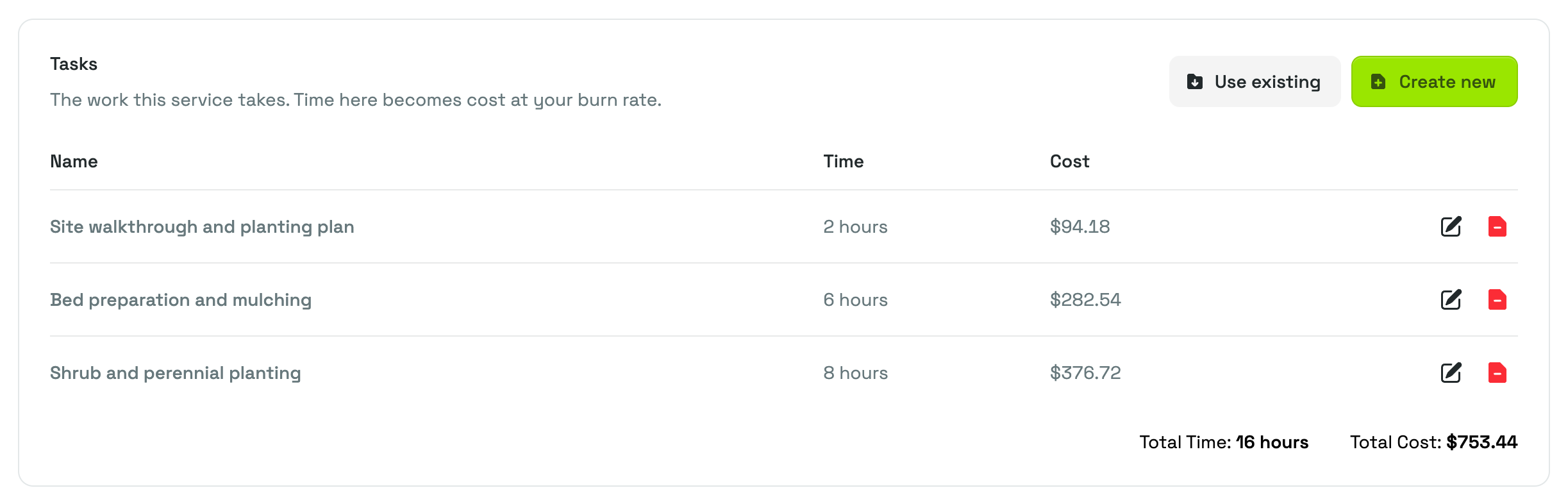
The Tasks card is where the work goes. Each task carries the time it takes, and that time becomes money at your burn rate.
You have two ways to add one:
- Use existing pulls in a task you already saved. Pick it from the list and Priscale fills in the preset time for you. Change the time if this particular service needs more or less of it; the saved task keeps its own preset time, so adjusting it here only affects this service.
- Create new lets you write a task from scratch, with a Name, a Time to Complete and an optional description. The task is saved for reuse at the same time, so the next service can pull it in with Use existing.
Time is entered as two fields, hours and minutes. Once a task is on the service, the table shows its Time and its Cost, and the totals under the table add up the Total Time and Total Cost of all the work. Use the pencil button on a row to change a task's time, or the remove button to take it off the service.
TIP
Tasks you have already saved don't show up twice: a task that is already on this service is filtered out of the Use existing list, and if the name of a new task matches one you already have, Priscale asks you for a different one, so your saved list stays clean. Use existing only appears while you still have a saved task that isn't on this service yet; otherwise Create new is the only button on the card.
Add the materials you buy or rent
The Materials card covers everything you have to purchase or rent for the job: the costs that aren't already covered by your burn rate.
It works the same way as tasks. Use existing pulls in a material you saved before and fills in its preset cost, and just like on the Tasks card it only appears while you still have a saved material that isn't on this service yet; Create new adds a new one and saves it for reuse. Each material on the service carries a Cost (the price of one unit) and a Quantity, and the table multiplies them into a Total per row, with the Total Cost of all materials underneath.
Changing the cost of a material on this service does not change the saved material, so a supplier's one-off price on this job won't follow you to the next one.
How the Production Cost adds up
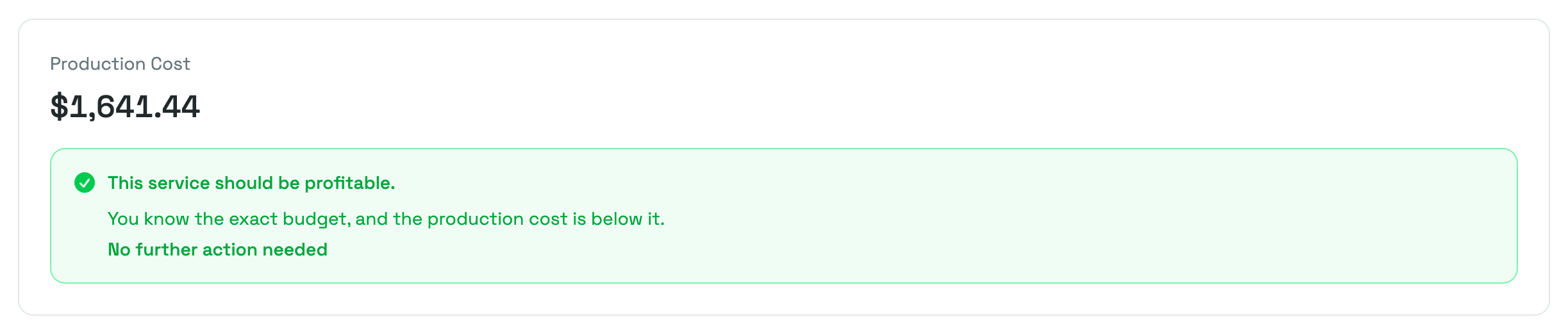
The Production Cost card at the bottom of the page is the point of the whole exercise: it is what this service costs you to deliver, before any profit.
Your time is priced at your burn rate, so more hours on a task means a higher cost, and every material total is added on top. Each time you add, edit or remove a task or a material, the production cost is recalculated straight away.
Underneath the number, Priscale tells you what it means for this job by comparing the production cost to the budget you entered:
- With no tasks and no materials, the production cost is zero and means nothing yet. Priscale says so rather than calling the service profitable.
- If you know the exact budget and the production cost is below it, the service should be profitable.
- If the budget is a guess, the verdict is softer in both directions: the service might be profitable, or very likely won't be.
- If the production cost has passed the budget, you'll be told to price at or above the production cost, and, when the budget is a firm one, to consider asking the client to renegotiate it.
WARNING
Each service keeps the burn rate it was created with, so an old service doesn't silently change price when your costs change. If your organization's burn rate has moved since, an Update Burn Rate button appears at the top of the page. Clicking it recalculates this service's task costs and production cost at your current rate.
Where fees fit in
Fees are not part of a service. A saved fee, like rush delivery, travel or permits, is a flat charge you add to an estimate, on that estimate's Adjust Estimate page, and it raises the estimate total rather than your production cost.
That difference is deliberate: the production cost is what the work costs you, while a fee is something you charge your customer on top of the work. If you chose Quote it with an estimate, the tasks and materials you set up here are copied into the estimate when it's created, and fees are added to it there.
Next steps
With the production cost settled, the rest of the flow is about the price:
- Service market value shows what a service like yours sells for elsewhere.
- Pricing a service covers choosing the price itself on the pricing spectrum.
- Managing services explains statuses, outcomes and the service detail page.
Related pages
- Burn Rate explains the hourly number your task time is priced at.
- Tasks and Materials cover building up your saved lists so services come together faster.
- Fees and Adjusting an estimate cover the charges that sit on an estimate.